
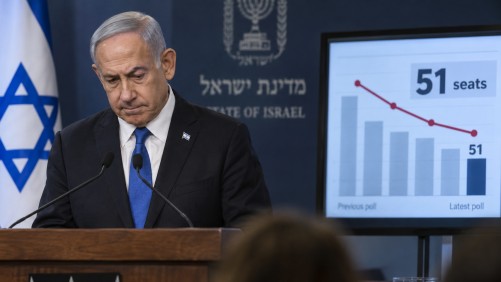
The potential for a political stalemate looms over Israel as new polling data suggests neither Prime Minister Benjamin Netanyahu’s bloc nor the main Zionist opposition can secure a parliamentary majority in the upcoming elections. With Netanyahu’s coalition projected to win only 51 of the 120 Knesset seats and the opposition slightly ahead with 55 seats, the path to forming a stable government appears fraught with challenges.
According to the poll, the two Arab-majority parties, which are predicted to secure a combined total of 14 seats, could play a pivotal role in coalition-building efforts. This scenario underscores the significance of these parties in the negotiation dynamics that are likely to unfold post-election.
The survey also revealed the emergence of former IDF chief Gadi Eisenkot’s Yashar party as a formidable political force, projected to become the largest party with 24 seats. Meanwhile, Naftali Bennett’s B’Yachad is expected to gain 14 seats, Yisrael Beytenu nine, and the Democrats eight, indicating a diverse political landscape.
Within Netanyahu’s bloc, Likud is poised to secure 22 seats, with Shas following at 10, United Torah Judaism at nine, Otzma Yehudit at seven, and Religious Zionism at four. However, newer parties such as Ofer Winter’s People of Israel, along with HaMiluimnikim and Blue and White, are falling short of the 3.25% electoral threshold needed to enter the Knesset.
In light of potential deadlock, public opinion is divided. While 31.4% of respondents favor another election if no majority is reached, 29.6% support forming a unity government, and 27% opt for a minority government. Among Netanyahu’s supporters, a significant 45.02% lean towards a unity government, whereas his opponents show a preference for a minority government at 39.79%.
The poll, which surveyed 500 individuals and carries a margin of error of 4.4 percentage points, highlights the ongoing uncertainty and complex political maneuvering expected leading up to the October 27 election.