
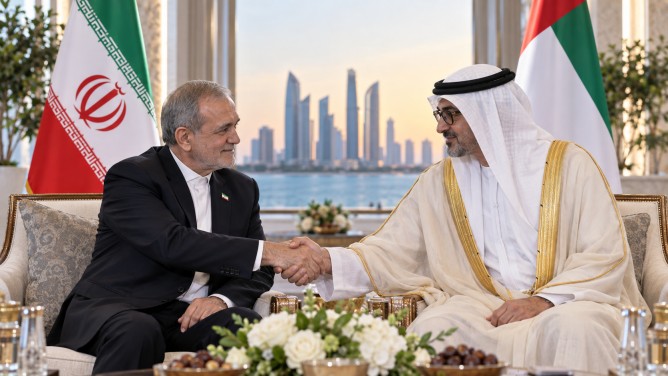
In a significant step towards easing regional tensions, Iranian President Masoud Pezeshkian announced that Iran and the United Arab Emirates are committed to “turning the page” and fostering improved relations. This statement followed his meeting with Abu Dhabi Crown Prince Sheikh Khaled bin Mohamed bin Zayed Al Nahyan at the BRICS Summit in New Delhi. Pezeshkian characterized the discussions as constructive, emphasizing a mutual agreement to focus on future collaboration.
This meeting represents the most high-profile interaction between Iran and the UAE since the escalation of conflict in West Asia. Previously, strained relations had led the UAE to suspend trade and financial engagements with Iran amid rising regional tensions. The dialogue between the two leaders centered on regional and global developments, highlighting de-escalation, stability, and efforts towards peace and development. Their conversation came in the wake of a joint statement signed by Iran, the UAE, and other BRICS members, advocating for restraint in ongoing conflicts.
Despite international sanctions, the UAE continues to hold economic significance for Iran, with Dubai serving as a key commercial hub for the Iranian community and facilitating economic activities. This economic connection underscores the importance of diplomatic engagement between the two nations, aiming to navigate past political and economic challenges.
Meanwhile, US President Donald Trump expressed no concern over the proposed meeting between Iran and Gulf states regarding the strategic Strait of Hormuz. This meeting was set to occur in Oman amid ongoing tensions between Washington and Tehran, highlighting the complex geopolitical landscape in the region. The discussions on the Strait of Hormuz are pivotal, given the strait’s significance as a critical chokepoint for global oil supplies.